Read our Google Birdeye Reviews
When you look at any cannabis package, scan for four things first: the universal THC symbol, potency in mg or percent, serving size if it’s an edible, and a Certificate of Analysis or batch number. Those four checks tell you whether a product is what it claims to be. If the batch number on the package doesn’t match the one on the COA, or there’s no COA at all, put it back. Some dispensaries treat that match as non-negotiable before anything goes out for delivery.
TL;DR:
- Always verify that the batch number on the package matches the COA to ensure product authenticity and safety, especially before consumption.
- Potency should be checked carefully: flower listing is in percent THC, while edibles show milligrams per serving; understand the difference and convert accordingly.
- Medically and for safety, confirm that the product displays the universal THC symbol, accurate warnings, and a recent COA with contaminant testing and lab details.
- When buying online, match the product photo’s batch number and COA link to your package to avoid purchasing outdated or untested products.
- Prefer fresh-packaged products, as terpene degradation over time can diminish effects and influence the actual experience, regardless of THC potency.
Table of Contents
- Anatomy of a Cannabis Label: Where to Find What
- Reading Potency: Percent, Milligrams, and What TAC Really Tells You
- How to Read Servings and Pace Your Dose
- What the Terpene Line Actually Tells You
- Safety Markings You Should Never Skip
- Checking the COA: Batch Numbers, QR Codes, and Red Flags
- Harvest Dates, Packaging Dates, and Why Freshness Changes the Experience
- Why Labels Look Different From State to State
- Applying Label Literacy to Same-Day Delivery Orders
- A Publisher’s Take on Reading Before You Roll
- Sources
Anatomy of a Cannabis Label: Where to Find What
Every legal cannabis package has two label zones, and knowing the difference saves you from hunting all over a jar for information that isn’t actually there. The Principal Display Panel is the front-facing part, the one you see on a shelf or in a product photo online. The information panel is everything else, often on the back or a fold-out flap.
The universal THC symbol, product name, and net weight or volume almost always sit on the principal display panel, since regulators want that information visible without picking up the package. Ingredient lists, batch or lot numbers, COA QR codes, and mandatory warnings typically live on the information panel instead.
- Principal display panel: universal symbol, product identity, net weight/volume, THC/CBD potency
- Information panel: ingredients, allergens, batch/lot number, COA access, health warnings, manufacturer contact
Small containers, like a one-gram concentrate jar, get some slack. Regulators allow accordion-style fold-out labels or instructions to check the outer box when the container itself is too small for full text, but the outermost packaging still has to carry every required disclosure in legible type, often no smaller than 6-point font.
Reading Potency: Percent, Milligrams, and What TAC Really Tells You
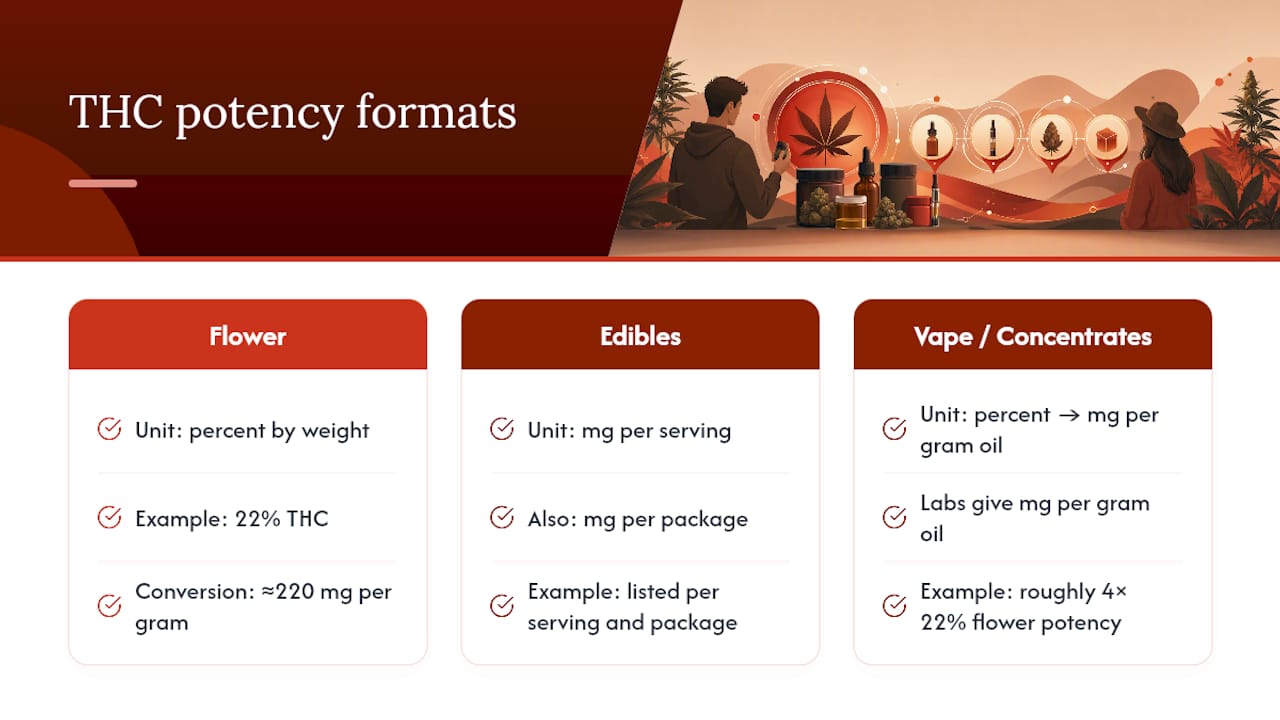
Potency shows up differently depending on what you’re buying, and mixing up the two formats is the single most common label mistake. Flower and other inhalables list THC as a percentage by weight. Edibles and beverages list it in milligrams per serving and milligrams per package. A jar of flower at 22% THC contains roughly 220 milligrams of THC per gram, which is useful math to keep in your head when comparing strains.
THCA vs. THC confuses almost everyone at first. Raw cannabis contains THCA, an inactive acid form that converts to psychoactive THC when heated. Labs often report THCA separately and apply a conversion factor near 0.877 to estimate potential THC after combustion, since THCA is heavier than the THC molecule it becomes. Total Active Cannabinoids (TAC) adds up THC, CBD, and minor cannabinoids to give a fuller potency picture than any single number alone.
Ratios matter too. A 1:1 THC:CBD product delivers roughly equal amounts of each, producing a milder, less intoxicating effect than a 20:1 THC-dominant product built for stronger psychoactive impact.
Quick math: A vape cartridge labeled with a high THC percentage contains roughly that many milligrams of THC per gram of oil, roughly four times the potency of flower testing at 22%.
Watch for two labeling traps: some brands list minor cannabinoids first to make a weak THC number look more impressive, and ratio notation occasionally gets printed backward. Always confirm which number is THC and which is CBD before assuming a product is balanced.
How to Read Servings and Pace Your Dose
Edible labels list two numbers that matter more than any other: milligrams per serving and servings per package. Multiply them, and you know your total dose for the whole package, not just one piece.
- Check mg per serving (commonly capped at a low dose per serving in many markets).
- Multiply by servings per package to get total package dose.
- For concentrates and vape carts, apply the percentage to grams consumed. A 0.3-gram dab from an 80% THC concentrate delivers roughly 240 mg total, split across multiple hits.
- Start with 2.5 to 5 mg for a first edible experience, then wait before taking more.
Edibles can take two to four hours (sometimes longer) to hit fully, which is exactly why so many people redose too soon and end up far more intoxicated than planned. Concentrate labels above 70% THC deserve extra caution from anyone new to dabbing. For a fuller breakdown of timing and pacing, our beginner’s guide to dosing edibles walks through real-world examples.
Pro Tip: Take a photo of the label before you eat an edible. If you need to redose later or something feels off, you’ll have the exact mg count and batch number on hand instead of trying to remember it.
What the Terpene Line Actually Tells You
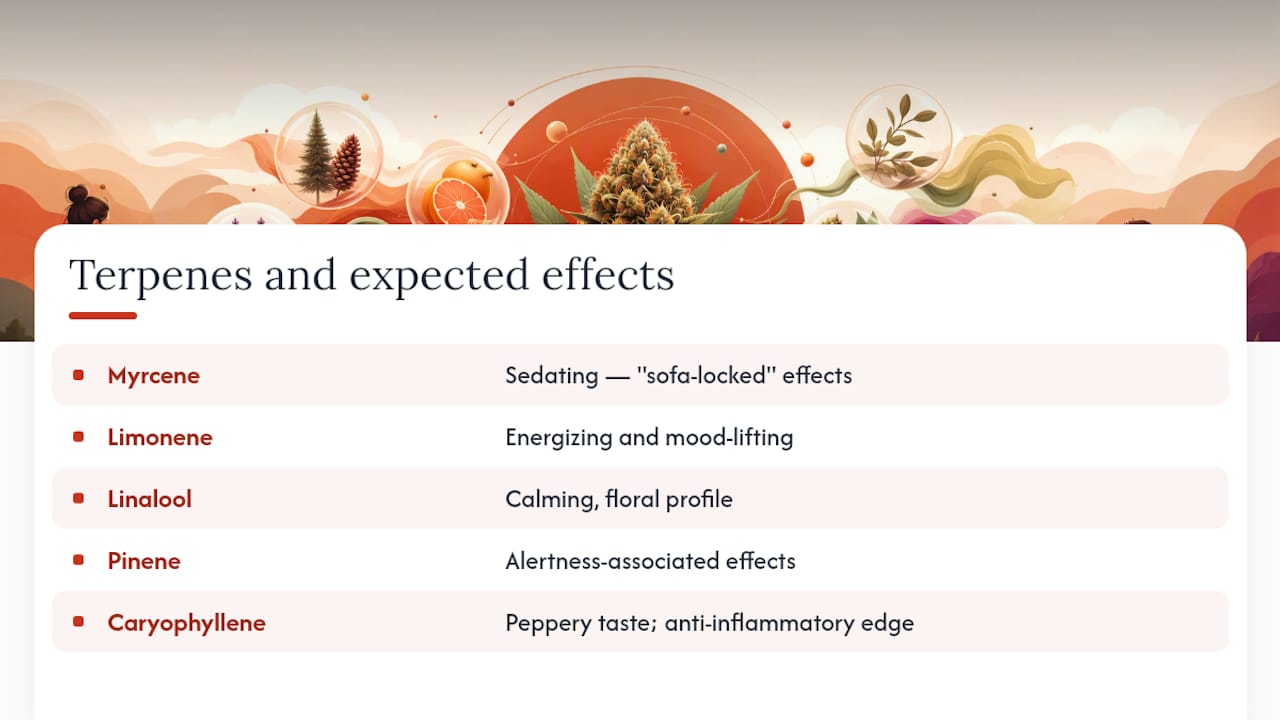
THC percentage measures strength. Terpenes measure character, and that distinction explains why two products with identical THC numbers can feel completely different. Myrcene tends toward sedating, sofa-locked effects. Limonene leans energizing and mood-lifting. Linalool shows up in calming, floral profiles. Pinene is associated with alertness, and caryophyllene with a peppery, anti-inflammatory edge.
Labels usually show either a total terpene percentage or a breakdown of dominant terpenes by name. A product listing “1.8% total terpenes, myrcene dominant” tells you more about how it will feel than the THC number sitting right above it. Some labels also list minor cannabinoids like CBG, CBN, and CBC, each associated with different roles beyond THC’s psychoactive effect. Our terpenes guide breaks down how to shop by profile instead of by THC alone.
Safety Markings You Should Never Skip
The universal THC symbol isn’t decoration. Regulators require it specifically so packaging stays recognizable even when branding and color use are deliberately restricted to limit appeal to minors. Alongside it, expect standardized warnings: keep out of reach of children, avoid use during pregnancy or while breastfeeding, and don’t drive or operate machinery while impaired.
- Universal THC symbol printed at a regulator-specified minimum size
- “Keep out of reach of children” and pregnancy/breastfeeding warnings
- Impairment warning covering driving and machinery
- Child-resistant, tamper-evident packaging
- Allergen declarations and, in many cases, nutrition facts for edibles
A multi-state review of cannabis labeling rules found that the overwhelming majority of states require batch numbers, health-risk warnings, and universal symbols, with delta-9 THC content and manufacturer contact information required almost everywhere. Edible labels in particular tend to mirror food-labeling rules, right down to allergen statements listed the same way you’d see them on a bag of chips.
Checking the COA: Batch Numbers, QR Codes, and Red Flags
The Certificate of Analysis is the one document that turns marketing claims into verified fact. A legitimate COA reports cannabinoid potency alongside contaminant panels for residual solvents, pesticides, heavy metals, and microbial growth, plus the testing lab’s name and the date the sample was tested.
- Find the batch or lot number printed on the package.
- Scan the QR code or visit the link printed on the label.
- Confirm the batch number on the COA matches the one on your package exactly.
- Check the test date. Anything more than a few months old on a fresh-looking product is worth questioning.
- Look for a full contaminant panel, not just a potency chart.
Pro Tip: No lab name, no test date, or a batch number that doesn’t match what’s in your hand? Treat all three as automatic red flags and skip the product, no matter how good the THC number looks.
Harvest Dates, Packaging Dates, and Why Freshness Changes the Experience
Cannabis labels sometimes show two separate dates, and they mean different things. The harvest date marks when the plant was cut. The packaging date marks when the product was sealed, and it’s the better indicator of shelf life at the point of sale.
Terpenes degrade over time, and a jar packaged months ago may test high on paper but smell and hit noticeably flatter than a recently sealed batch. Freshness often predicts the actual experience better than the THC number on the front of the label. When two products show similar potency, favor the more recent packaging date, and match the batch number to make sure the COA you’re checking actually belongs to what’s inside.
Why Labels Look Different From State to State
Cannabis labeling rules vary by jurisdiction, and the differences aren’t cosmetic. New York requires specific minimum font sizes for required text, while Oregon and New Jersey guidance sets its own dimensions for the universal symbol and separate rules for small containers.
- Font-size minimums and symbol dimensions differ by state
- Small containers may use accordion labels or fold-out panels
- Required info must stay on the outermost layer, not just a removable inner seal
If a container looks too small to carry full information, check the outer box or the retailer’s product page. The COA link should be there even when the label itself isn’t.
Applying Label Literacy to Same-Day Delivery Orders
Reading a label online works the same way as reading one in hand, just through a product photo and a linked COA instead of the object itself.
- Confirm the COA link or QR code is visible on the product page
- Match the batch number shown online to the one on your delivered package
- Check mg per serving and total servings before adding an edible to your cart
- Note the testing lab’s name and test date for your own records
Reputable online dispensaries verify tested inventory against current COAs before it ever reaches a menu and make that information easy to find without digging. Hang onto your batch numbers. If a concern ever comes up with a product, that number is what lets you report it accurately. Ready to put this into practice? Compare formats on our flower vs. vapes breakdown before you place your next order.
A Publisher’s Take on Reading Before You Roll
Four checks, every time: universal symbol, potency in mg or percent, serving size, and a COA that actually matches your batch number. Skip any one of them and you’re guessing, not buying informed. Start low, go slow, especially with edibles and anything testing above 70% THC.
Some delivery businesses have built their reputations on that same discipline, verifying tested product before it reaches customers’ doors. Keep your batch numbers. Report anything that seems off. That habit protects you more than any single potency number ever will.
— Jake
This article is general information, not a substitute for advice from a qualified doctor. Consult a qualified healthcare professional about your own circumstances before acting on anything here.
Sources
- Part 128: Packaging & Labeling Guidance | Office of Cannabis Management
- Reading a Product Label | Washington State Liquor and Cannabis Board
- Packaging and labeling guide | Oregon Liquor and Cannabis Commission (OLCC)