Read our Google Birdeye Reviews
A vape battery’s mAh rating tells you how many puffs you get before the next charge, not how hard each puff hits. Milliampere-hour (mAh) measures stored energy, so a 300 mAh pen might get a light user through a day, while a 1,100 mAh mod holds enough charge for heavy, all-day sessions. Voltage and coil resistance, not mAh, control how intense each draw feels.
TL;DR:
- A higher mAh rating indicates longer session endurance, but it does not affect the strength or intensity of each puff.
- Puff count per charge varies significantly based on voltage, coil resistance, draw length, and oil viscosity, with moderate use typically yielding 300 to 600 puffs.
- Battery safety depends more on proper discharge rating and avoiding overheating than on capacity alone, especially for high-mAh cells.
- Proper charging habits, such as avoiding full discharges and hot environments, extend both daily runtime and overall battery lifespan.
- Mismatched or excessively large capacity batteries increase safety risks if discharge ratings are inadequate for high-wattage setups.
Table of Contents
- What Does mAh Mean for a Vape Battery?
- How Many Puffs Do You Get Per mAh?
- Which Battery Size Fits Your Vaping Routine?
- Disposable, Rechargeable, or Removable: How mAh Changes by Device Type
- How Long Do Vape Batteries Actually Last?
- How to Get More Puffs Per Charge and Extend Battery Life
- Why High-mAh Batteries Carry Extra Safety Risks
- The Trust Behind This Guide
- A Straight Answer on What Actually Matters Here
- Ready to Shop Smarter, Not Just Bigger
- Sources
What Does mAh Mean for a Vape Battery?
Think of mAh as the size of a fuel tank, not the size of the engine. A milliampere-hour is a unit of electrical charge. One mAh means the battery can supply one milliamp of current for one hour before it runs dry. Stack more mAh into the same cell and you get more stored energy, which usually translates to more sessions between charges.
Here’s where people get confused: mAh has nothing to do with how strong a hit feels. That job belongs to voltage and wattage, which set the power delivered to the coil, and to coil resistance, which determines how much current flows at a given voltage. A battery can carry 1,500 mAh and still fire weak, watery hits if it’s dialed down. mAh measures capacity, not intensity, and mixing the two up is the single most common mistake buyers make when comparing devices.
There’s a third spec worth knowing: Continuous Discharge Rating (CDR). This is how much current a cell can safely output at once.
- Higher CDR matters more for sub-ohm and high-wattage setups than raw mAh does.
- A high-mAh cell with a low CDR can still overheat under heavy pulls.
- Pairing capacity with the right discharge rating is what actually keeps a device safe under load.
How Many Puffs Do You Get Per mAh?
The honest answer: it depends on voltage, coil resistance, draw length, and oil viscosity, but real-world data gives you a solid starting point. Runtime guidance from vape battery manufacturers maps common capacity bands to realistic puff and session counts, and the pattern holds across most 510-thread devices and pod systems.
These numbers come from Ooze’s practical runtime guidance, and they assume moderate draw lengths at moderate voltage. Push any of those variables and the math changes fast.
- Higher voltage settings drain a charge faster, even on the same mAh cell.
- Lower-resistance coils pull more current per puff, cutting total puffs.
- Longer draws (the kind common in sub-ohm or DTL setups) burn through capacity quicker than short MTL sips.
- Thicker, higher-viscosity oil can force harder, longer pulls to get a full hit, indirectly shortening runtime.
Two quick examples make this concrete. A moderate MTL vaper taking short, two-second draws on a 500 mAh cartridge battery might comfortably clear 300 puffs before recharging. A heavier DTL-style vaper pulling longer, cloud-chasing draws on the same 500 mAh battery could burn through it in half the puffs, simply because each draw pulls more current for longer. Manufacturer-rated puff counts also tend to run optimistic since they’re often measured using short, one-second test draws that don’t match how people actually vape.
Which Battery Size Fits Your Vaping Routine?
Battery size is really a trade-off between runtime, portability, and how often you’re willing to plug in. Matching capacity to your actual habits saves you from carrying a brick-sized mod you didn’t need, or constantly hunting for an outlet with an underpowered pen.
- 300–400 mAh: Slim, pocket-friendly pens built for light or occasional use. Expect a shorter runtime but a device that disappears in your pocket.
- 500–650 mAh: The sweet spot for most daily 510-thread cartridge users. Enough juice for a full day of moderate sessions without adding much bulk.
- 900–1,100 mAh: Built for heavier daily use or all-day sessions. These run noticeably longer between charges, though the device itself gets thicker and heavier.
- 1,500 mAh and up: Common in box mods and higher-power setups where sub-ohm coils demand more sustained current, not just more total capacity.
Charge time scales with capacity too. A 350 mAh battery might top off in under an hour, while a 1,100 mAh cell can take two hours or more on a standard charger. USB-C fast charging is closing that gap on newer devices, cutting charge times significantly compared to older micro-USB batteries, though the exact speed still depends on the charger’s output and the battery’s own charging circuit.
Disposable, Rechargeable, or Removable: How mAh Changes by Device Type
The mAh number means something different depending on what kind of device you’re holding, and reading it the wrong way leads to bad comparisons.
- Disposables advertise a fixed puff count rather than a raw mAh figure, but that puff count is essentially a stand-in for a small built-in battery, usually in the 300–600 mAh range depending on the model. Convenience is the trade-off. There’s no charging involved, but once it’s dead, it’s trash.
- Built-in rechargeable pens and pod kits list a manufacturer-stated mAh, and real-world runtime usually lands close to that spec if you’re vaping at moderate settings. Typical 350–500 mAh pens last roughly a day for light-to-moderate users, though pushing higher voltage settings shortens that window.
- External or removable cells (common in box mods) separate capacity from safety in an important way. A high-mAh 18650 or 21700 cell paired with a low CDR can still be a poor match for a high-wattage sub-ohm setup. Capacity and discharge rating have to be evaluated together, not swapped in as substitutes for each other.
If you’re trying to decide between formats entirely, a closer look at cart versus disposable options breaks down the practical trade-offs beyond just battery specs.
How Long Do Vape Batteries Actually Last?
There are two separate clocks running on any vape battery, and mixing them up leads to unrealistic expectations. One is per-charge runtime, how many puffs you get before needing to plug in. The other is total lifespan, how many charge cycles the battery survives before it noticeably degrades.
Most consumer vape cells tolerate roughly 300 to 500 full charge cycles before capacity starts dropping off in a way you’ll notice. In calendar time, that typically works out to somewhere between six months and two years, depending on how often you vape and how well you treat the battery.
Three habits shorten that lifespan faster than anything else:
- Letting the battery sit fully drained for extended periods.
- Charging with a mismatched or off-brand charger not rated for the device.
- Exposing the battery to high heat, whether from a hot car or direct sunlight.
Best practice is simple: use the charger that came with the device or one explicitly rated for it, unplug once it hits full rather than leaving it topped off overnight, and store it somewhere cool and dry. Our vape battery safety guide covers the full charging checklist in more detail.
Watch for these warning signs that a battery is done, not just tired:
- Visible swelling or a warped casing.
- Noticeable heat during normal use, not just heavy chain vaping.
- A sudden, sharp drop in how many puffs you’re getting per charge.
Pro Tip: Stop using any battery that feels warm to the touch just sitting idle. That’s not normal, and it’s not worth testing how far it goes before something worse happens.
How to Get More Puffs Per Charge and Extend Battery Life
Small habit changes add up to real gains in both daily runtime and total battery lifespan. None of these require buying new gear.
- Vape at the lowest voltage setting that still satisfies you. Dialing down even slightly stretches every charge.
- Take shorter draws instead of long, dragging pulls. Chain vaping back-to-back drains a cell fast and generates heat.
- Charge to full and unplug rather than leaving the device connected overnight on a trickle charge.
- Avoid letting the battery run all the way to zero repeatedly. Keeping charge in a moderate range, roughly between 20% and 80%, helps preserve long-term capacity.
- Wipe down the battery-to-cartridge contact points occasionally. Buildup there causes weak connections that force the battery to work harder than it should.
- Store batteries partially charged, not empty, if you’re not using a device for a while, and keep them out of hot cars or direct sun.
Pro Tip: If you’re switching between a cart and charging mid-day, check whether your specific device is rated for pass-through use first. Some batteries handle it fine; others don’t, and it’s worth confirming before you rely on it.
Why High-mAh Batteries Carry Extra Safety Risks
Bigger capacity isn’t automatically safer, and in some ways it raises the stakes if something goes wrong. A high-mAh cell simply stores more energy, which means more energy gets released if the battery fails, whether through a short circuit, physical damage, or a manufacturing defect.
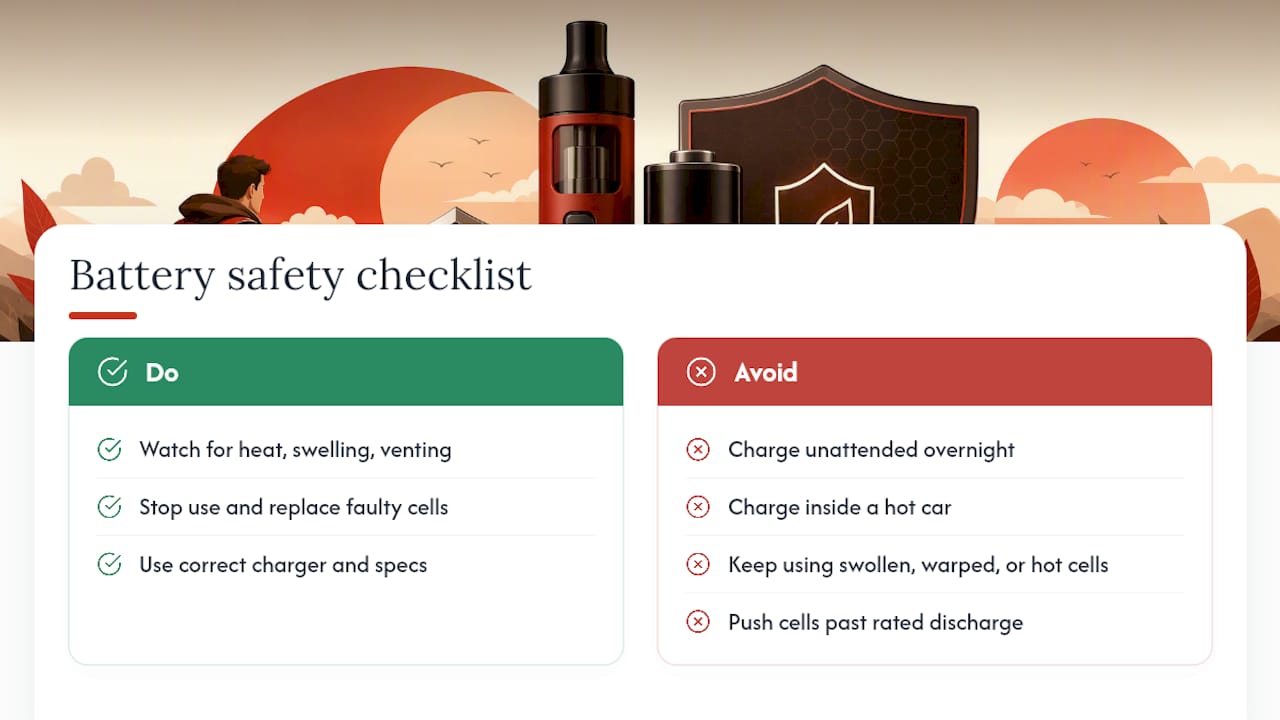
Overheating is the most common warning sign, and it usually shows up before anything worse happens. A battery that feels hot during normal, moderate use, not heavy chain vaping, is telling you something is off. Venting, where a battery releases gas or swells as a safety response to internal pressure, is a more serious signal and means the cell needs to be retired immediately, not just given a break to cool down.
High-mAh external cells used in mods carry an added risk factor: mismatched Continuous Discharge Rating. A cell can carry a large capacity number and still lack the discharge rating a high-wattage sub-ohm setup demands. Pushing a cell past its rated discharge draws too much current too fast, generating heat the cell wasn’t built to handle.
The safest habits are straightforward. Never charge a battery unattended overnight on an unfamiliar charger, never leave a device charging inside a hot car, and never continue using a cell that’s swollen, warped, or unusually hot to the touch. If you notice any of those signs, stop using the device and replace the battery. Our vape battery safety rules walk through the full set of red flags in more depth.
The Trust Behind This Guide
The New York City cannabis market has seen many questions about battery specs, charging habits, and why a device died faster than expected. That experience shapes the practical, no-nonsense advice in this guide.
If you’re weighing device types before you buy, our comparison on carts versus disposables covers the trade-offs beyond just mAh. And if you’re wondering whether it’s safe to hit a device while it’s plugged in, our guide on charging and hitting a STIIIZY answers that directly. Education like this sits alongside every order we deliver, because a battery that’s charged correctly and used safely lasts longer and performs better every single session.
A Straight Answer on What Actually Matters Here
Most guides bury the one thing that actually changes your buying decision: mAh only tells you about endurance, never about how a device feels to use. People upgrade to a bigger battery expecting stronger hits and end up disappointed, because the upgrade they actually wanted was a lower-resistance coil or a higher wattage setting, not more capacity.
The overlooked variable is CDR, and almost nobody outside serious mod users tracks it. If you’re pairing a removable cell with a sub-ohm setup, checking the discharge rating matters as much as checking mAh, maybe more. A cell that can’t keep up with a device’s power draw is a safety problem waiting to happen, regardless of how big its capacity number looks on the box.
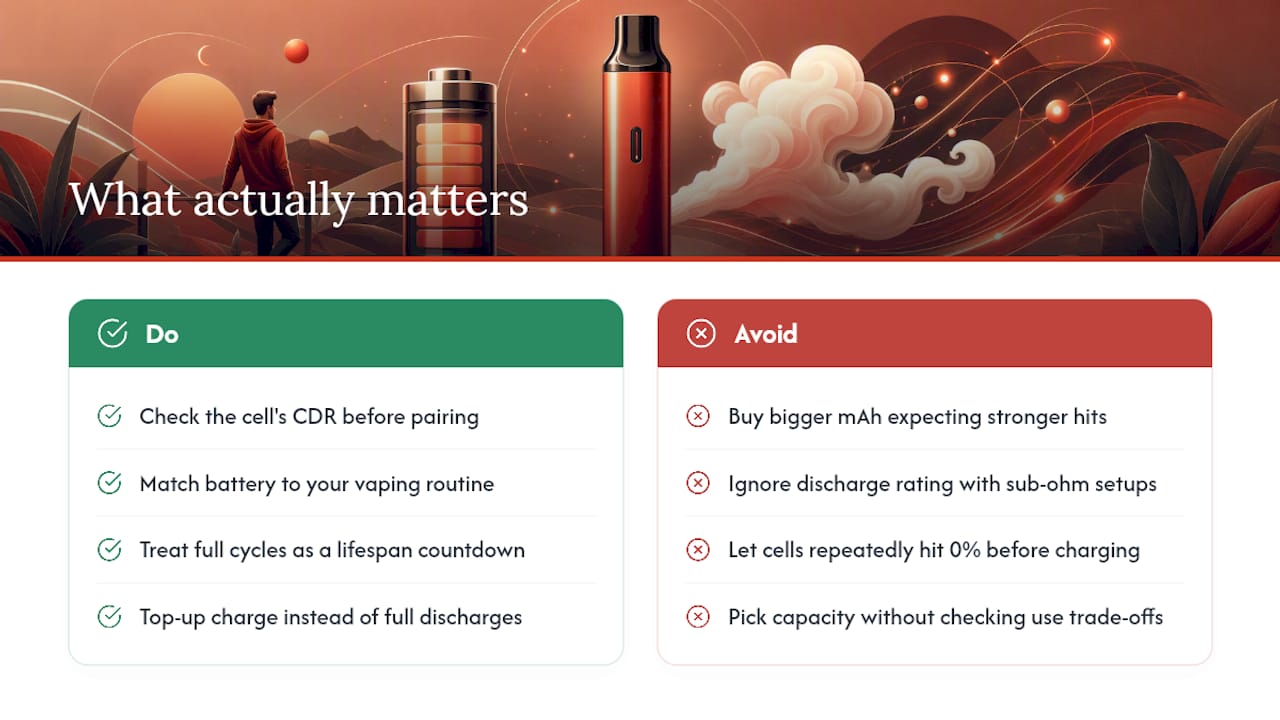
If there’s one habit worth adopting from everything here, it’s treating charge cycles like a countdown rather than an afterthought. Every full discharge to zero and back to 100% chips away at total lifespan a little faster than a top-up charge would. Small changes in how you charge add up to a battery that still performs well a year or two down the road, instead of one that quietly loses half its runtime by month six.
For anyone comparing devices before a purchase, it’s worth reading how vaping stacks up against other consumption methods, including the trade-offs covered in flower versus vapes, before locking in a battery size that doesn’t actually match your routine. And for a broader look at vaporizer formats and convenience trade-offs generally, this rundown on vaping methods is worth a read too.
— Jake
Ready to Shop Smarter, Not Just Bigger
Picking the right battery size beats guessing at a bigger number every time, and practical detail is essential on every product page and delivery. Instead of scrolling through spec sheets that don’t explain what they mean for your actual routine, this guide aims to provide straight answers and tested product information to help with your needs.

If battery safety is on your mind, our vape battery safety guide walks through charging habits and warning signs in plain language, no jargon required. Deciding between a disposable and a rechargeable cart? The cart versus disposable breakdown lays out exactly which fits your routine. When you’re ready to browse tested, verified vapes with delivery windows that fit your day, head to our full menu and place an order today.
Sources
- What Does MaH Mean on a Battery? Vape User Guide | Ooze Life
- What Does mAh Mean? | Yocan
- How Long Does a 510 Vape Battery Last? (Charge vs Lifespan) | VapingVibe
- Vape Battery Lifespan: 5 Essential Tips – Zaleaf