Read our Google Birdeye Reviews
Stack it all together and a typical adult-use retail purchase in NYC carries a combined effective tax burden that public rate estimates put at around the low twenties percent once state and local components are combined.
TL;DR:
- The combined effective tax burden on a typical adult-use cannabis purchase in New York City is around 21.5 percent.
- Taxes include a wholesale excise paid by distributors, a retail excise paid by retailers, and potency taxes that vary from $0.005 to $0.03 per milligram of THC depending on product type.
- Retailers must register with the NYS Tax Department separately from the dispensary license and file quarterly returns, even if they have zero sales, to avoid penalties.
- Potency taxes are calculated based on lab COAs, with edibles taxed at six times the rate of flowers due to higher THC content per milligram.
- Tax revenue supports public education, community reinvestment, and drug treatment programs, with distributions managed quarterly to counties and municipalities, including New York City.
Table of Contents
- Understanding NYC Cannabis Taxes: A Line-by-Line Breakdown
- Who Pays NYC Cannabis Taxes and When Are They Due
- How Potency Taxes and Medical Exemptions Actually Work
- Compliance, Penalties, and What 280E Decoupling Changes
- How These Taxes Show Up in Your Final Price
- Where NYC Cannabis Tax Revenue Actually Goes
- A Delivery Retailer’s View on NYC Cannabis Tax Lines
- Where to Verify NYC Cannabis Tax Rules Yourself
- Why the Tax Conversation Misses What Actually Matters
- Sources
Understanding NYC Cannabis Taxes: A Line-by-Line Breakdown
Two separate excise taxes exist because New York taxes cannabis at two different points in the supply chain, not once. The wholesale excise is paid by the distributor when product moves from cultivator or processor to a licensed retailer. Registered organizations or microbusinesses that skip the middleman and sell directly to consumers still owe that excise, but only on part of the retail sale amount rather than the full price, according to the NYS Tax Department’s adult-use cannabis guidance.
The retail excise applies at the point of sale to the consumer and is remitted by the retailer. This excise includes a state component plus a local share earmarked for New York City, based on the structure detailed in Cannabis CPA’s 2025 New York tax guide.
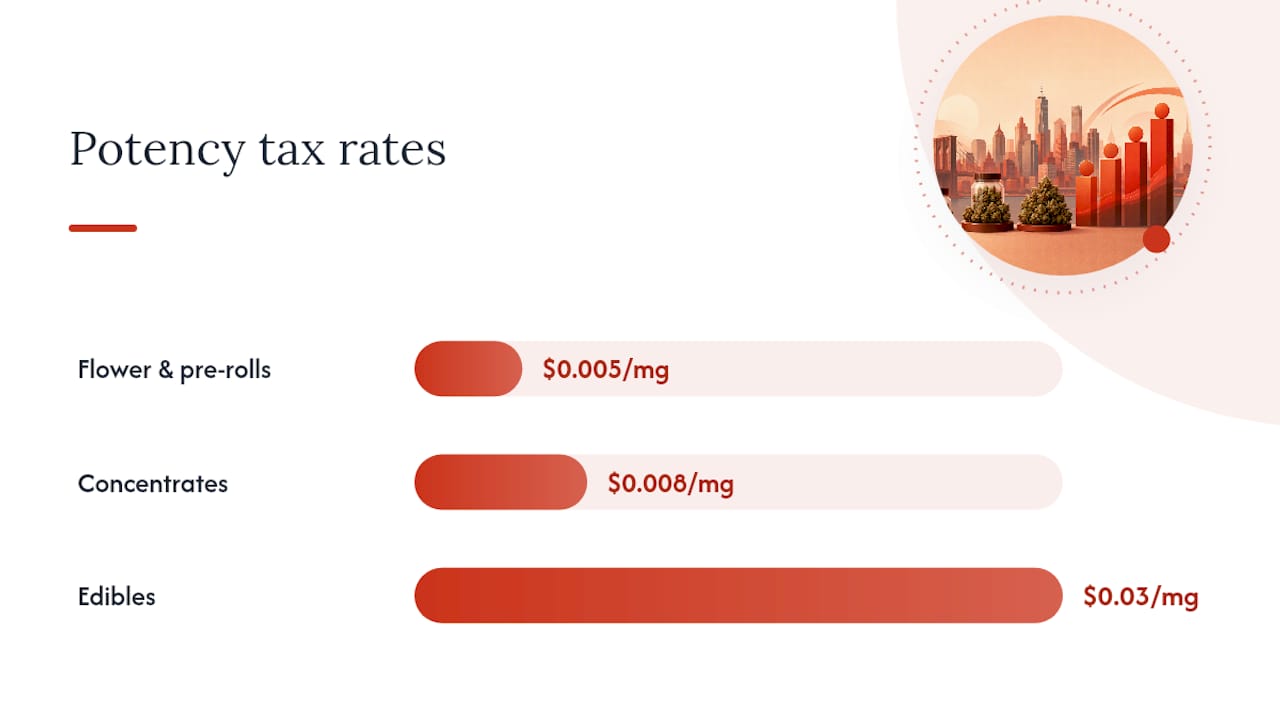
Then there’s potency. New York taxes THC content directly, not just price, using these per-milligram rates:
- Flower: $0.005 per milligram of THC
- Concentrates: $0.008 per milligram of THC
- Edibles: $0.03 per milligram of THC
Who Pays NYC Cannabis Taxes and When Are They Due
Getting registered correctly determines whether you’re filing the right form at all. Here’s the sequence:
- Secure your Office of Cannabis Management license first. No tax registration matters until you hold a valid cultivator, processor, distributor, or retail dispensary license through Cannabis.
- Register with the NYS Tax Department separately. The OCM license and the tax registration are two different steps, and skipping the second one is a common new-operator mistake.
- Determine your remittance role. Distributors remit the 9% wholesale excise; retailers remit the 13% retail excise plus potency tax on top of the sale price.
- File quarterly through the NYS Web File portal. Adult-use excise returns are due the 20th of the month following each quarter’s end. That means deadlines fall on June 20, September 20, December 20, and March 20.
- File even with zero sales. A quiet quarter doesn’t excuse you from filing; a zero-sales return is still required to stay compliant.
Missing a deadline doesn’t just cost money. It puts your OCM license at risk during renewal review, since tax delinquency shows up in state compliance checks.
How Potency Taxes and Medical Exemptions Actually Work
Every lab certificate of analysis, or COA, lists total THC as a percentage. Convert that percentage to milligrams per package weight, then multiply by the applicable per-mg rate. A 100mg THC gummy pack, taxed at $0.03/mg, adds $3.00 in potency tax before the retail excise applies to the shelf price.
Statistic Callout: The potency rate spread is wide by design. Edibles at $0.03/mg tax at six times the rate of flower ($0.005/mg), which is why a low-dose edible can carry a higher tax-per-dollar ratio than a comparably priced concentrate.
- Flower and pre-rolls use the lowest per-mg rate, reflecting typically lower total THC per package.
- Concentrates sit in the middle at $0.008/mg.
- Edibles carry the highest rate at $0.03/mg, based on figures from Cannabis CPA’s tax guide.
Confirming a customer’s medical registration status before checkout matters more than most retailers assume. Curious how edible potency plays out at the register? Dosing edibles safely walks through real-world THC math.
Compliance, Penalties, and What 280E Decoupling Changes
Late filing costs a penalty per month, capped at a maximum percentage, plus accruing interest, according to NYS Tax Department rules. That penalty stacks fast on a business already running thin retail margins.
Recordkeeping is where most audit exposure hides. Keep these for at least three years:
- Sales logs broken out by product type and potency
- Transfer and manifest documentation between cultivator, processor, and distributor
- Lab COAs tied to each batch sold, since potency tax calculations depend on them
New York decoupled from federal 280E at the state level, meaning cannabis businesses can now deduct ordinary business expenses (rent, payroll, marketing) on their New York state returns even though federal law still disallows those deductions for plant-touching businesses. That decoupling meaningfully improves state-level cash flow, even though the federal 280E burden remains untouched.
Pro Tip: Reconcile your potency tax calculations against your COAs monthly, not quarterly. Catching a mislabeled batch before a filing deadline is far cheaper than amending a return after the fact.
Regulatory tightening isn’t unique to New York. International shifts in CBD regulatory certainty show the same pattern: jurisdictions that clarify tax and compliance rules early tend to see steadier retail growth than those that leave operators guessing.
How These Taxes Show Up in Your Final Price
Run the math on a straightforward flower purchase:
- $50 pre-tax: Add roughly $1.00–2.00 in potency tax depending on THC percentage, then apply the 13% retail excise to the combined subtotal. Expect a final price in the $58–60 range.
- $100 pre-tax: Potency tax scales with quantity and strength, often landing around $2–4, with the 13% excise pushing the final total to roughly $115–120.
- $200 pre-tax: Higher-potency concentrates or larger flower orders can push potency tax past $8–10, with the full stack landing the final price near $230–240.
Statistic Callout: Public rate estimates put New York City’s combined effective cannabis tax burden around 21.5% once state excise, potency tax, and the local share are all stacked, per Cannabispromotions. Treat that as a ballpark, not a receipt line, since your exact rate shifts with product potency and category.
Retailers generally handle this stack three ways: pass the full tax through as a visible line item, absorb part of it into a lower base price to stay competitive with the illicit market, or raise base prices modestly and let the tax stack ride on top. Delivery buyers curious about exactly how this breaks down on a real order should check how NYC weed delivery taxes appear on receipts.
Where NYC Cannabis Tax Revenue Actually Goes
Collected tax dollars don’t sit in one pot. New York’s framework directs revenue toward public education, community reinvestment grants for communities affected by past cannabis enforcement, and drug treatment and prevention programs.
- The Office of the State Comptroller manages public reporting and quarterly distribution of adult-use cannabis tax revenue to counties and host municipalities, including New York City, according to OSC’s revenue data.
- Distributions generally run on a quarterly cycle aligned with January, April, July, and October reporting windows.
- Host counties and cities receive a local share tied to dispensary activity within their borders, which is part of why the 4% local component exists inside the 13% retail excise.
City budget reporting has noted year-over-year growth in cannabis tax receipts as the retail market matures, even as insiders debate whether the current rate structure is sustainable long-term for smaller operators, per NYPost’s 2026 coverage.
A Delivery Retailer’s View on NYC Cannabis Tax Lines
Most customer confusion about NYC cannabis taxes happens at the receipt, not at checkout.
Clear tax presentation matters as much as accurate calculation. A handful of practices separate well-run delivery operations from ones that generate support tickets:
- Break out potency tax and retail excise as separate receipt lines instead of folding them into one lump “tax” figure.
- Process medical orders through a separate workflow so the 3.15% gross receipts rate never gets mixed into adult-use totals.
- Keep COAs on file and accessible per batch, since potency tax disputes get resolved fast when the lab data is one click away.
- Review delivery windows and order cutoffs regularly. Cannabis delivery hours in NYC affects when tax-inclusive pricing needs to be locked in for same-day orders.
Pro Tip: If you’re comparing a vape cart to flower on price, remember the tax math differs by category. Flower vs. vapes breaks down where potency tax actually lands heavier.
Where to Verify NYC Cannabis Tax Rules Yourself
Don’t take secondhand summaries as the final word on your filing obligations. The NYS Tax Department’s adult-use cannabis page covers registration and filing mechanics directly. The Office of Cannabis Management handles licensing rules and maintains dispensary listings. OSC’s local government data page shows exactly how revenue gets distributed to counties and NYC. For the statutory language behind the current structure, the Senate bill S854A legislative text is the primary source.
Why the Tax Conversation Misses What Actually Matters
Most coverage of NYC cannabis taxes fixates on the headline rate and stops there. That’s the wrong focus.
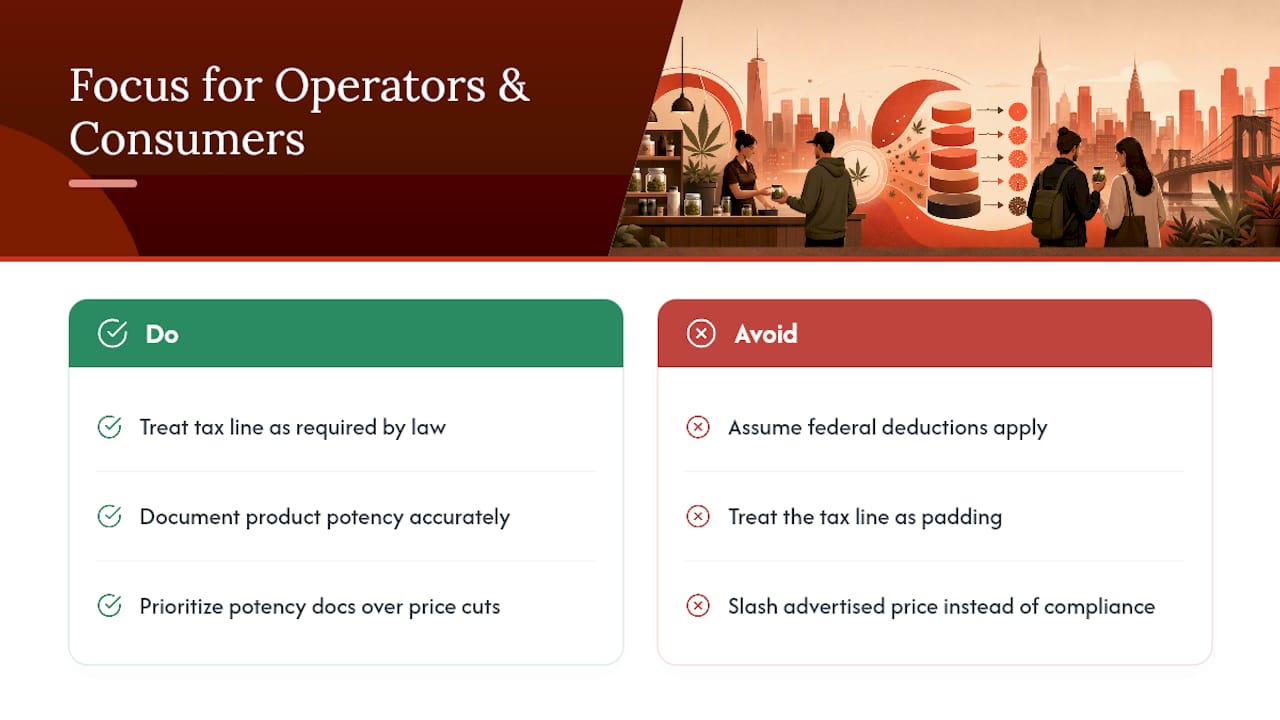
The bigger blind spot is 280E decoupling. Plenty of operators still budget as if federal deduction limits apply at the state level too, leaving real cash on the table every filing period. That’s a compliance win most retailers haven’t fully priced into their operations yet.
If you’re a consumer trying to make sense of a receipt, stop assuming the tax line is padding. It’s doing exactly what state law requires, potency and all. If you’re an operator, the priority isn’t shaving your advertised price to compete with the illicit market. It’s nailing your potency documentation so your tax calculations survive an audit without a scramble.
— Jake
Ready to see how tax math plays out on an actual order? Browse the current menu at High Fashion Smokes & Prints and check out the live resin vs. distillate comparison before you order, since potency differences between concentrate types directly affect what you’ll see on your final receipt.
This article is general information, not a substitute for advice from a qualified financial advisor. Consult a qualified financial professional about your own circumstances before acting on anything here.
Sources
- Tax
- New York Cannabis Tax Guide: 2025 Edition – Cannabis CPA Tax
- Adult-Use Cannabis Tax Revenue and Retail Dispensaries in New York State – OSC
- Cannabis